 Rembrandt courtesy of artrenewal.org
Below is the scripture from the book of Mathew;
From the sixth hour until the ninth hour darkness came over all the land. About the ninth hour Jesus cried out in a loud voice, "
Eloi,
Eloi, lama
sabachthani?"—which means, "My God, my God, why have you forsaken me?"When some of those standing there heard this, they said, "He's calling Elijah."Immediately one of them ran and got a sponge. He filled it with wine vinegar, put it on a stick, and offered it to Jesus to drink. The rest said, "Now leave him alone. Let's see if Elijah comes to save him." And when Jesus had cried out again in a loud voice, he gave up his spirit.

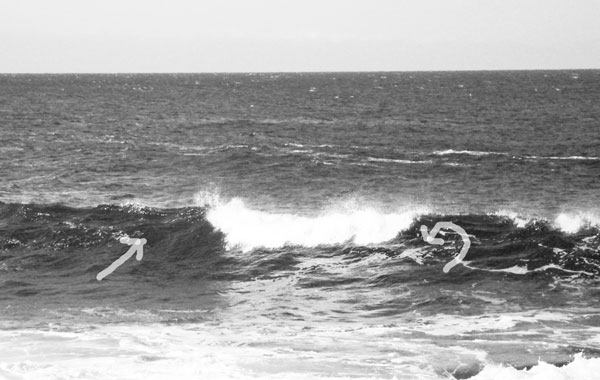
Above is a breaking wave, Last night we look at the beginning of this process, here is the classic view that
seascape painters so often paint. The wave has broken, that is, the water from the back of the wave, moving faster than its slowing front wall has rushed over the front and fallen against the face and base of the wave. The water explodes into foam. Look at the left hand break and notice a few things. The water curves down in a semicircle. On that edge as it hits the face of the wave it begins to convert to foam in ever increasing amounts. As more and more water reaches the base of the wave it creates ever larger and often globular masses of foam. Below is a Frederick Waugh ( a devout Christian incidentally ) showing this in paint.
 Waughs
 knowledge of the anatomy and form of the wave makes the anatomy of the breaker clear. It is so much better than the photo. This is an example of the problems encountered by those who try to copy a photo to make a seascape and the limitations of that. Because of the
enormous size of the waves Waugh has shown the foam purposefully sliding down the face of the oncoming wave. He has
characterized the globs into which the foam erupts to show the shapes that it takes. It looks thick like whipped cream.It has volume and weight. Behind the foam, is the back of the wave driving forward, and to the left behind that, we see the foam that has passed over the back of the advancing wave. Notice how the foam "grows" at the bottom of the semicircle as more and more water cascades down the front of the wave. Waugh has the whole thing
backlit, that is something seascape painters love to do. This lighting shows up the form of the wave best, see how the foam is divided into light and shadow, just like on a figure or still life.
The second smaller wave over to the left shows another interesting thing about waves. the water breaking over the front is in an up plane and lives in the world of the light. That's important. That passage will often
progress into the shadow on its way to the foam. The broken patterns of the foam from a previous wave are formed as the growing wave stretches it and tears elongated semicircular holes in it as the mass of the water increases. It is still functioning like a skin stretched over the orb of energy below the surface. Unlike the water though, the foam doesn't stretch very well, so it tears into holes and tatters. These foam patterns show the shape and planes of the rising face of the wave.
This is a powerful and extremely original design. It is arrangements like this that make Waugh so extraordinary.
 Above is a wave in the next stage, it has broken along its entire front and is now spent. The whole boiling mass of foam has been displayed and the wave begins to collapse, or better for or artistic purposes, it runs into a rock or headland. When that happens the foam explodes upwards often with a loud bass roar and spray shooting skyward. I call it, the giant puffball. Below is one of those. It too has its own distinctive anatomy. Lets explore that a little.
 The spray in the giant puffball has form like anything else. Part of it is in the light and part is not, it also has within it variations caused by some parts of it catching the light and other parts in the shade, These are often relieved against one another like above. This also gives a look of volume. The spray rebounds from the rocks and its top is often carried away by the wind.
 This is front lit and that gives definition to the various clumps or ropey shapes in the burst. Portraying this is always a game of sort edges and slightly harder accents. Below is my late friend Charles Vickery. Vickery used to come into my tiny gallery and sit at my easel. He would do little demo paintings for me. He didn't much explain it as he did it though. I took a workshop with him in the mid eighties. He explained a lot then. I wish I could find my notes from that. I know I have them somewhere.
 He did seascapes every day for many , many years and got REALLY good at it. I am proud to have known him. This image is from a dealer who handles his work http://www.charlesvickery.com/gallery/




 Posts
Posts

