 © The Estate of Edward Seago, courtesy of Portland Gallery www.portlandgallery.com
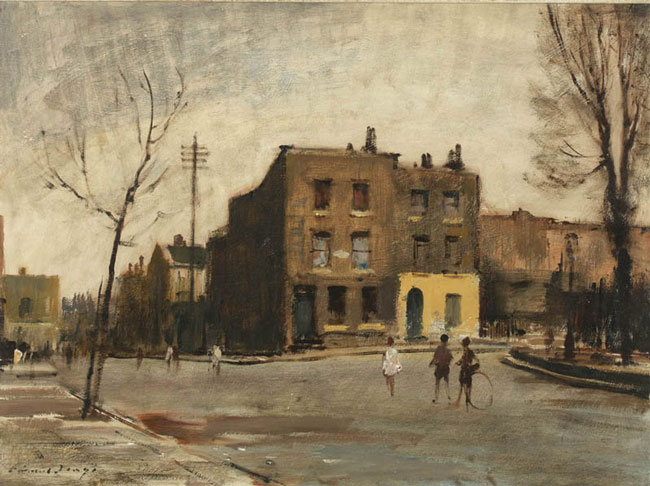
Above is an example of a painting by another great landscape painter, Edward Seago. 1910-1974 I apologize for having cropped the right hand side of the picture slightly, although for our purposes here it shouldn't matter too much.As I am sure you have noticed I champion a lot of lesser known 20th century artists. I have every book on him I can find. They are all British and till now, out of print.
Seago used to be absolutely unknown in America but that is evidently changing. He was very well known in England, and was collected by the royal family. Seago sold out shows routinely. Although he was very successful financially, Seago was ignored or dismissed by the art press of his day. Perhaps a little like Norman Rockwell, he was thought of as lowbrow, I guess. Time has raised our brows some. He lived and worked at the low ebb of traditional painting. I will tell you the story of his somewhat tragic life tomorrow.
There are now two available books on Seago,
Both are full of excellent color reproductions.
1.

Buy new: $29.74
17 Used & new from $20.00
Usually ships in 2 to 3 weeks
Eligible for FREE Super Saver Shipping.
 (3)
Other Editions: Hardcover

They may be had through Amazon .I wouldn't be surprised if studying these books radically changed how you approach landscape painting. Ron Ransom is himself a painter and has spent many years studying Seago, so his notes on the paintings are useful in contrast to so many art books with good plates and dim commentary.
Seago was a master of handling and edges, and design, he could do it all. However I will begin by talking about his edges, because that is the subject at hand, isn't it? Lets look at this detail of the piece.

Seago has done something I briefly mentioned a post or so back. You see it done with the branches of trees, by a lot of landscape painters but Seago uses it all over his paintings. That is the dragged paint application you see in the branches on the right hand side of this detail. Now this painting is 22 by 36 so what you are seeing is pretty big, so Seago is a loose painter. Real brushy too.
Look closely at the branches there and notice something else. They are dragged over a texture already existing on the canvas. That texture is not part of the brushwork or impasto of the day that Seago painted that branch over it. He has pre-textured the canvas. In a future post I will describe several ways of doing that. What this does for Seago is it gives him a way to soften or obliterate his edges and he uses it everywhere. It is one of the "secrets" of his technique.
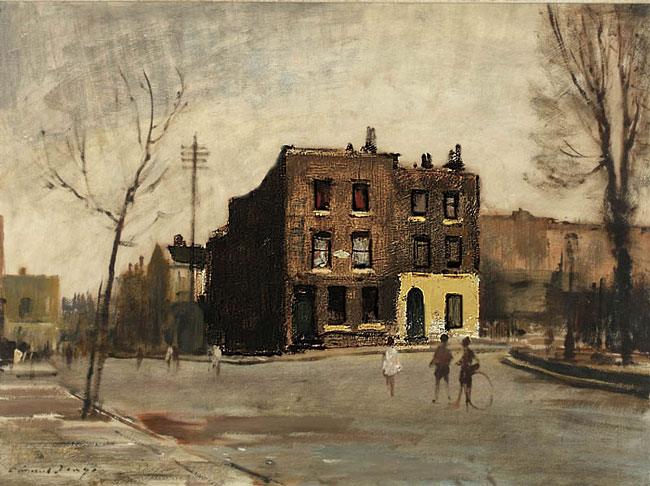
If you click on the top image you will get a larger view of the painting and can see this crumbled brush stroke is all over the painting. So long as he kept out of his medium, this edge was automatically "softened". He had to thin his paint to get a hard edge such as that on the houses in the middle of the painting. Notice how the bright one with its gable end facing us, is layed in with a knife. Crisp.
The whole foreground is just big overlapping brushstrokes of different colors but the same value. That also gives edge control. He throws in a couple of accents and the viewer does the rest. You can almost watch this picture painting itself.
Tomorrow I will dissect this painting some more, particularly how the various means of controlling edges have aided Seago in controlling the viewers eye.




 Posts

