I am going to begin to move on to actually painting these trees we have been
dissecting. I use the word
dissecting because what I have been writing about is tree anatomy. In the comments we have discussed a book written in the early 20
th century by an artist named Rex
Vicat Cole called "The Artistic Anatomy of Trees". I learned a lot there, if there were a bibliography for this series of posts, Cole would be at the top. It is not easily read though and goes into a lot of detail that is extraneous.
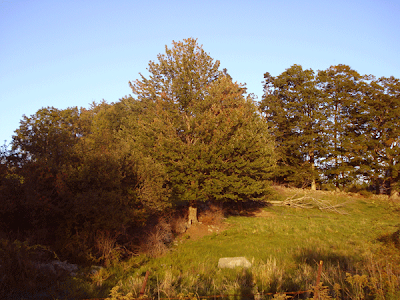
Here is a grouping of trees that we might set up to paint. Below is the same group of trees with the general lines indicated.
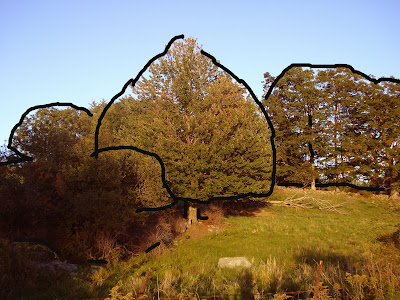
In order
to get this scene onto my canvas I would draw their outlines something like this. There are about five big shapes there. One of the reasons this scene is
attractive is because each of those areas is a
different size and shape. As the artist trying to get the picture up and running I need to plan out the simplest "blueprint" of my shapes I can. Now,I drew these lines on the picture with
photoshop, which is for me a pretty clumsy affair. If I were working in paint on canvas the lines would be softer. Theses lines look a little like coat hangers, but I think you get the idea. This is a summary, here's another.
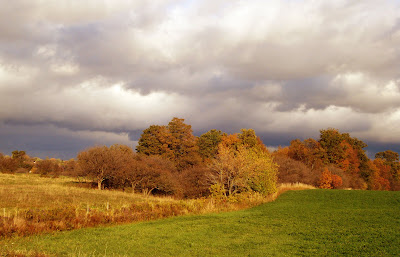
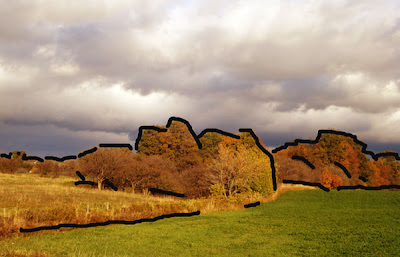
Above is the scene and below are the summary lines that
would start a block in of the painting. These lines are merely the greatest simplification of where the landscape is and carry the least amount of detail. The details of the edges of the forms are averaged or rounded off. However if you can get this much information onto your
canvas you are well on your way to "taming" a scene like this.
Below is the same photo with a few more lines on it. They show the larger " hidden" lines in the forms. You want to look for these and lightly indicate them.
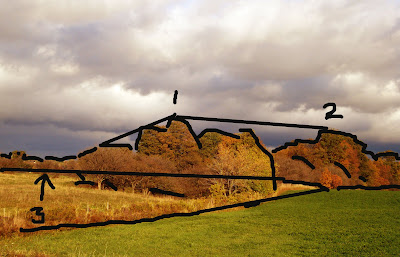
Notice the relationship between 1 and 2,
by finding that line between the two and checking
its angle you find a lot about about their placement. Look at
line 3, see what happens if you imagine it running behind that central group of trees and emerging on the other side. Notice where it would intersect that foreground diagonal were that extended. These continuation of existing lines show relationships between different objects in the scene. Look for them. It is a helpful way to avoid working piecemeal, which is where you have everything on the canvas, but not in its right relationship to everything else. This is a geometric measuring system.
 This grand old tree stands by a roadside here in New Hampshire. It is composed visually of several layers. You have probably seen an opera set or a ballet stage that has flats, or layers of scenery receding back into the space of the stage. Imagine that tree above the same way. The nearest flat, would be the leaves in the light, behind them the next layer is the shadowed interior of the tree, the third layer is the branches, and the fourth layer is the sky behind the tree. I want to spend a little time in some upcoming posts on each of those layers. The first layer I want to address is the skyholes, the patches of sky that appear through the tree within its outline.
 I have drawn some lines within the interior of this tree to haul those random holes together into a rhythmic order. If you just scatter those holes about they will look too assertive and each one standing on its own will call for the viewers sole attention. Thereforeit is better if they are related to one another, a constellation of sky holes rather than the machine gunned look. Notice how those lines all have an arching similarity. If the sky holes are influenced by an invisible geometric structure suggested beneath them, they will be simpler and more effective. The idea here is like yesterdays manner of finding order in a grouping of trees, but today we are trying to find order within the tree itself. The lines above represent not the tree itself but the general flow of the skyholes seen through the limbs. I will be back on sky holes tomorrow.


 Posts
Posts

