Tuesday, August 14, 2012

Partying with the The Hudson River Fellowship


Lauren Sansaricq and Erik Koeppel


I got a phone call the middle of last week from Nathan Sowa, a member of the Hudson River Fellowship. The Hudson River School fellowship is a yearly gathering of young painters, many from The Grand Central Academy in New York. The Grand Central Academy is highly regarded as the most elite of the new ateliers training young artists.

http://grandcentralacademy.blogspot.com/2012/07/hudson-river-fellowship-week-2.html


They submit portfolios and if selected spend a month painting in the field with a group of 30 artists. This year they worked in Jackson, New Hampshire. That is in the Mt. Washington Valley in the White Mountains. In the 1860's many of Americas greatest landscape painters summered in the Mt. Washington Valley. The guidebooks in those days called it the "Switzerland of America"

Nathan suggested that I come up and paint with them for a day, I jumped at the chance. I have known about the group for years and wanted to see for myself what they were doing. This year's Fellowship began with many of the students taking a ten day workshop with Erik Koeppel. Erik was written up in Plein Air magazine this month. I knew he had recently moved to New Hampshire and I was glad for the opportunity to meet him.

Erik usually does drawings outside as preparatory studies for paintings made in the studio, exactly as his 19th century heroes did, on the same locations that he is working.

Erik has spent years studying the methods of the Hudson River School painters. His paintings really do recall the work of that first generation of American landscape painters, artists like Thomas Cole and Asher B Durand. Erik has a DVD showing his methods that will be available soon. I will get a copy. I don't want to paint like a Hudson River School guy myself, but there is a lot to be learned here.
http://www.erikkoeppel.com/

 Erik's partner, Lauren Sansaricg also studies the Hudson River painters, below is one of her paintings.


On Thursday night I met my friend Jerome Green in Hyannis Mass. We went to a concert featuring Kim Simmonds, Edgar Winter, Johnny Winter, Leslie West and Rick Derringer. Those are all guitar heroes. I, of course, mostly went to see my friend Kim Simmonds, guitarist and founder of the legendary Savoy Brown Blues Band.

After the concert I drove back to New Hampshire, a several hour trip, and then slept for a few hours. On Friday morning I drove up to Jackson. That's on the other side of the mountains from mine so it is about a 2 and 1/2 hour drive. I arrived there and it was raining. It was my 60th birthday. I got to spend it teaching, I 'll take that!

This was their last night in the White Mountains and because of the rain there was little to do except have a party. There were about twenty or so of the fellowship hanging around at their rental house, so I went into my showbiz mode. I did a sort of mini workshop and lecture at them. I talked about landscape painting and making your living as a painter. They were also interested in hearing about my first teacher R. H. Ives Gammell, who is a famous figure to the classical painting revival. They asked me lots of questions and I did my best to answer them. They have had many teachers but have probably not known too many people who make their living painting.

We had dinner, take out pizza, and then I set up my easel and did a seascape demo in the corner where I was out of the way, but if anybody wanted to watch they could. It was not the best demo I have ever done. There was very little light.  I think my Rockport ways of working were very different from the measured approach they have all studied in the atelier. I was taught that way too, but I have long since developed my own less formal ways of doing things. They were probably shocked.

I guess their average age might have been about 22. They were college age , I would call them art students, but the atelier program they are in is far more demanding and structured than most art schools. They draw casts and figures, they study anatomy and work in mostly late 19th century technique.

They had good drawing skills and some of them seemed to have experience painting the landscape. Below is particularly fine effort by Zoey Frank. Isn't that  a fine painting? I met Zooey, she will be a fine painter before she is done.


Brian MacNeil working at his pochade (pronounced pochade) box. He is a Bostonian and is a both a tattoo artist and a painter. I asked him if he would please quit putting tattoos on women, but he told me that was the best part of his job. Below is one of his paintings of the Wildcat River above Jackson. I have painted there many times it is a spectacular place to work.


Below are some studies also done on the river by Nathan Sowa. Nathan arrived from an extended stay in Sweden and has taught for the Florence Academy of Art, another classical atelier.


The fellowship had done an  exhibition, that was well received, the night before in Jackson and there were many sales made. That which didn't sell was stacked all over the tables and around the house.This was the last night of the fellowships stay in Jackson. I missed meeting a few students who had already departed.


Nathan Sowa


The revival of interest in classical painting means that there are again young students working to learn the skills of a traditional painters craft. When I was studying in the mid 1970's almost no one had any interest in doing this kind of art. Today  dozens of ateliers train young artists in classical painting. They seldom have taught much about landscape though. Usually they confine themselves to figurative and still life painting.But the atelier training is an enormous asset for the would be landscape painter.Of course landscape painting is its own thing and after studying in an atelier few of these students will choose to become landscape painters. But those who do will be well prepared. Landscape painting has it's own set of skills. A painter is always a student.


Above is another painting of the Wildcat River by Connor DeJong. This artist is 19 years old. I have shoes older than that. I really enjoyed meeting these young artists. You would think that I would meet lots of young painters but I haven't. Until recently there weren't very many young people interested in classical painting. I sat in a gallery in Rockport, Mass. for 14 years and never had an art student express any interest in what I was doing, in the entire time I was there. T.M. Nicholas and I set up our easels in Savannah once and painted 30 by 40's a couple of blocks from the famous "name brand" art school there. None of the hundreds of students passing by with their portfolios under their arms bothered to walk the few paces out of their way and see what we were doing.

There is a tide flowing in the art world. It is ignored by the museums and the art schools but hundreds of young people are learning traditional painting techniques. I am certain that it will have an effect on our nations art. Some day one of them may actually get to show one of their paintings in a museum, besides the Alex Katz portraits and Damien Hirst seafood under plexi aberrations. It is glacial, but a shift is slowly occurring. These are hip, smart, beautiful young men and women who will be the artists that will live to see traditional painting accorded some attention by the official  art institutions. I am 60 now, I  don't believe I will live to see it, but they will. This has been generations in the making. My own teacher R.H. Ives Gammell began training young people in the 1950's hoping to preserve some of the accumulated knowledge of our culture before it was forever lost. In his day perhaps dozens of young people were working to learn this art, today many hundreds are.

----------------------------------------------------------------------------------------------------

I am lining up a number of workshops for the fall, more than in previous years. They seem to fill and I enjoy teaching when I can do it in 3 day spurts and then go back to my own painting. I have a bunch of workshops coming up.

ANNOUNCING A MINNESOTA WORKSHOP!
Several people have asked me if I would do a workshop in Minnesota. The workshop will start on September the 15th and run though the evening of the 17th in (well, near) Stillwater,  Minnesota. Stillwater is an easy drive from the cities so participants can commute, or stay in one of the many motels or inns in this historic river town.
 There should be some autumn color and the greens of summer will have burnt off some by this time. This is getting into the best time of the year to paint outside. Woods and fields are a great subject at this time of year. Minnesota has lots of oaks that look real good in the late summer and fall. I grew up in Minnesota and will enjoy painting that landscape again. I am going to bring in some special guest stars to teach a little too.. I will tell you  a little more about that soon.

I will do the Stapleton Kearns show. So come out to Stillwater and join me. I can save you years of screwing around! The link to sign up is below.


http://stapletonkearns.blogspot.com/search?q=Minnesota+Workshop+Fall+2012


Here is the link to sign up for my fall workshop in the White Mountains. This is a total immersion program and I run the class about 12 hours a  day. I do an evening lecture while we wait for dinner to be served.The fall color in the White Mountains is legendary and people come from all over the world to see it. In the 19th century all of the great Hudson River painters made a point of being there too, just a few miles up the road from the inn.Sign up here;


http://stapletonkearns.blogspot.com/2012/05/workshops-for-sale.html

Saturday, August 4, 2012

Another little trick I know 4


Here is a  little trick for stretching canvas. When I start stretching a canvas I put a staple in the middle of each side. As you can see above the tension is uneven around that first staple. Before I drive the next one, I grab the end of the canvas up at the corner and pull it taut. I still have the canvas pliers in my other hand pulling the canvas as you see above. I pull it just as hard as I can.


I grab the canvas up there at the corner and pull it so that the canvas is tensioned not only across the stretcher but along it's length as well. It would help to be an octopus to do this. I release the hand up at the corner and use it to hold the staple gun to drive the next staple between the initial one and the corner. I space my staples about two inches apart. I do this for the first two or three staples on each side. That little tug helps prevent buckling or an uneven tension across the length of the side I am stretching.

I thought I would throw this in here too. This is a reprint from a previous post, but it certainly falls into the little tricks category

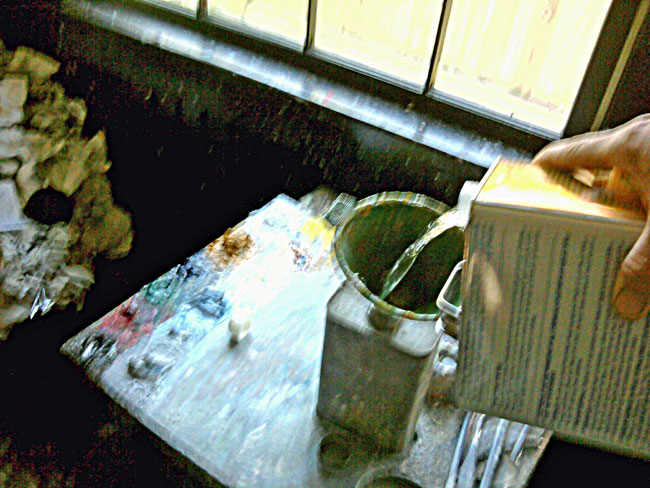
There is a trick to pouring from a new can of solvent. For years every time I did it I got turpentine all over. Then someone showed me how to do it. The trick is to turn the can over. Pour the solvent ACROSS the top of the can, like in the grainy cell phone picture above. You will need to hold your mouth just right for this to work, but try it, no more turpentine filled shoes!
There are about a million little tricks in painting.


 Above is pictured a device that sits on my easel. It is just a couple of stretchers screwed to the top and bottom of a length of 1 by 10. What it does is elevate the painting I am working on. I am 32 feet tall, so almost all easels are too short for me. I can't crank them up them up high enough to comfortably work on smaller canvasses, This one is an 18 by 24. The other thing it does is allows me to put a larger canvas on the easel quickly by removing this "easel stilt" rather than having to adjust the height of the easel itself. Notice that I have a half sheet of luan plywood sitting on the easel behind my painting. This allows me to tape my reference photos or inspirational reproductions of relevant master paintings next to what I am working on. It also eliminates the distraction of seeing whatever is behind the easel around my painting.


.....................................................................................................................

I have scheduled another workshop in the White Mountains for the autumn color season.  This is a first, I have never done a fall workshop up there. It should be a great time to paint the Presidential range from the Inn overlooking Franconia Notch. If you are interested, click on the link below and it will give you all the information about signing up. I limit the workshops to 10 participants, that keeps them a workable size and they almost always fill up so if you want to come, sign up before it is filled.


 Fall Color Workshop  September 8th through 10th


 This is the Sunset Hill Inn in Franconia, New Hampshire. I have been teaching workshops there for about three years and it is the ideal location.  Because I have taught so many workshops there the inn keepers have learned what painters at a workshop need and they are now practiced at hosting my workshops and making sure we have what we need to operate without any distractions or responsibilities other than painting.There is a broad rear porch that overlooks the mountains so we can still paint outside no matter what the weather does. The lower level of the inn  is ours to store our paints and canvas so we don't have to haul it all to our rooms and it makes a good place to teach too. The view of the mountains is spectacular and in the fall it will be even better. The inn takes good care of us. We have our own private dining room too. They handle  our meals and even bring us lunch so  we can work all day uninterrupted. The inn is one of those big old historic affairs from the 19th century and is homey and informal. Most of the rooms have gas fireplaces, it is cool in the evenings up in the mountains in the fall, so that is nice after a day outside.

 This will be the first fall workshop I have done there and I am thrilled. I love teaching workshops anyway. Everyone is always excited to be there and hang out with the other artists. It is like a three day party. We go from breakfast until bedtime. This is a total immersion program and I run the class about 12 hours a  day. I do an evening lecture while we wait for dinner to be served.The fall color in the White Mountains is legendary and people come from all over the world to see it. In the 19th century all of the great Hudson River painters made a point of being there too, just a few miles up the road from the inn. We don't need to leave the grounds of the inn  to find great subject matter so their is no problem with hauling easels around or caravanning cars to daily locations. We just walk out the back door and the whole Presidential range is spread out before us.

The schedule includes;
  • a demo every morning, on the first day I explain the palette and the various pigments.
  • In the afternoon the students paint and I run from easel to easel doing individual instruction and try to diagnose each students particular barriers to better painting.
  •  after the demo each day I run  a series of exercises  teaching root skills like creating vibrating color and the parts of the light (that is what you need to know to establish light in a painting) I am going to add a new exercise this time on color mixing.
  • I do a presentation before dinner with images from my laptop. One is a history of White Mountain art so you can see what the greats of American painting did with the same landscape we will be painting during the day. The other is unpacking  the design ideas in the works of great landscape painters, particularly Edward Seago and Aldro Hibbard, two favorite artists of mine.
  • I promise I will work you like a borrowed mule.


If you have never seen autumn in New England this is your chance to paint the most spectacular fall color in America.The cost of the workshop is 300 dollars, I charge a 150 deposit up front when you register. In return for that I will hold your place in the class. I won't give away your place to anyone else, so I don't return deposits. If you don't intend to come, don't sign up!
It is nessasary to stay at the in . However in the past several people have asked if they could stay with their brother in law or pitch a tent a nearby campground. If you want to do that, it's OK but you will have to pay a flat fee of 150 dollars to the inn for the use of their facilities. That fee will include your breakfasts, lunches and one dinner.The link to sign up is below;

http://stapletonkearns.blogspot.com/2012/05/workshops-for-sale.html

Monday, July 23, 2012

Another little trick I know 3


I don't paint much with a knife, well sometimes, but..... I scrape with my knife a lot. I like sharp tools, in my workshop, I like my brushes sharp, and I sharpen the edge of my palette knife too. I use the sort of knife that has an offset blade. I get mine from Jerrys Artarama and I buy the  Liquitex knives. I expect there are fancier knives out there but these work for me. I have snapped off way too many cheap knives where that offset neck meets the leaf shaped blade that were made by the Chi-Coms . The Liquitex knives seem to be of a better metal and I haven't had that problem with them. I like to scrape the surface of my canvas to take the surface down to  a smooth finish before resuming working on a dried canvas. I use an alkyd medium so my paintings dry quickly. The alkyd (Liquin) that I add to my medium makes the paint a little rubbery too and that makes it scrape well. I can slice the ridges and pentimenti from my canvas better than if I don't use an alkyd medium.

I use a sharpening stone from the tool department of a hardware store or big box vendor. I put a little sharpening stone oil on there and hone the edge of the knife that will be doing the work. As I am right handed that would be the left hand edge as viewed from the top. I work it until it is fairly sharp. I don't need or want, a razors edge, that might cut me as I work with it, but it is a lot sharper than your  palette knife.  Give it a few quick passes on the backside of the cutting edge to remove the hook like ridge that builds up there after honing the working edge. Just a couple of passes will do that.

My sharp palette knife takes the painting to an almost glass like surface even if there are ridges of paint left from yesterdays ministrations. Often I will hold the tip of the knife blade pinched between my fingers and bend the blade into a scythe shape to slice off an individual ridge of paint.


I slip a little Masonite panel behind the canvas to protect it if I have to scrape over where a there is a stretcher bar. If you don't do this you will leave a mark on the front that will show through your paint as the knife chops into the surface when it encounters the hidden stretcher bar beneath.


I went seascape painting this last week. I escape all the summer greens by heading to the water . Here is a a video of that. I take a lot of these little movies, they are better than still photography for studying the action  of the surf. This is from my Sony Cyber-Shot camera not a digital movie camera. It will take a long enough video to catch the entire action of a couple of waves.


Monday, July 16, 2012

A letter from William Paxton


 I will return to my little tricks series, but first a for an interesting artifact from art history.


I was allowed to reprint this nearly 100 year old letter courtesy of Tom Dunlay, a well known New England impressionist painter. I suppose I should explain the players here, they are;

William Paxton (1869–1941) the author of the letter, I have decorated the page with a few of his paintings. A major American impressionist painter. He was a student first  of Dennis Miller Bunker and then in the Parisian atelier of Leon Gerome, a member of the Boston  School group of painters and a founding member of the Guild of Boston Artists. He was a National Academician and successful portrait painter commissioned to paint both Grover Cleveland and Calvin Coolidge. Below is his painting Tea leaves from the American wing of the Metropolitan Museum of Art.

Henry Brooks (1898-1981), a student of Paxton who  was touring Europe with,

R.H.Ives Gammell , painter, teacher and writer, author of  "Twilight of Painting". Incidentally, my teacher as well. Also the teacher of Tom Dunlay who provided the letter for us to read.

 19 Montvale Road
Newton Centre

Dear Brooks;

Your good letter made me quite envious of your luck.

The Ingres exhibition must be intensely interesting— at least
it would be to me. Of course you'll have to swallow hard to take in
some of his color, but if you consider it as a means of emphasizing
his drawing it becomes very interesting, and I think you'll get to
like it.

The Vermeer head that you speak of and the Mona Lisa are, to my
mind, the two top notch performances in modelling in the world. The
Da Vinci charms me more, but the Vermeer is surely more truthful in
total effect.

Here I am writing like "dear teacher" and probably boring you
stiff, but even at the rist (sic)of that I'll ask you to examine the way
in which every picture which interests you is made.

The beauty, greatness, style, or whatever the salient quality
of a picture is, you'll get anyway, but, if you don't look sharp, the
way it's done, will escape you.

It's fine to sit open mouthed while the conjurer takes the rabbit
from the hat, but if you want to be a conjurer it's up to you.to find
out how he does it-

That fact is a rather grubby comparison but I want to make it
clear that the artists task is to create the emotion rather than to
be moved.

No doubt one who has never felt emotion is incapable of
communicating it to others, but most of us have felt it, and

William Paxton
2.

few can pass it on. Don't let the old master over awe you, and don't
get cheeky with them either. Most of them had something or they
wouldn't be Old Masters.

Look at them as you would look at your friends work: find the faults
and praise the qualities. There is no reason • for a different standard
of criticism than the one you use for your contemporaries.

You may lose some pleasure by finding how the wiser are pulled but
think of the pleasure you can give others if you \ learn how it's done.

As I look over this that I have written I'm tempted to throw
it away as it seems neither original or new, but as I want you to
know that I'm keenly interested in your work, and this will perhapes (sic)
show it, I'll let it go.

The pulchritudinous Edna is still on the job and occasionally
expresses her yearning for your return and also that of Gammell. It seems
only fair to state that her affections seem divided.

By the way: when you get to Venice be sure to see the
Museo Civico (spelling doubtful). There are samples of drawings
by Tielapolo(sic) and delightful things by Guardir (sic,Gaurdi) and Longhi. There
is no news to write. . . .

"The purple days of drouth expand like a scroll opended out
again.1* Well—I "drink to you only with minor eager" for obvious
reasons.

With best regards to everyone interested and particularly

 to yourself and Gammell, I am,

 Yours truly;

 William Paxton

July 7, 1921.


........................................................................


https://mail-attachment.googleusercontent.com/attachment/?ui=2&ik=18a7965dc1&view=att&th=138916a002afd577&attid=0.2&disp=inline&safe=1&zw&saduie=AG9B_P_7NBJPyqZC09U_ts_CElDL&sadet=1342484950558&sads=7l4e0ROdc7TuaQlOWmP9GAsnuOM


 Here a plug for a new vendor of quality brushes and a reader of this blog, Joe Salamida. I want some of these brushes and will be glad not to have to order them from England. The mongoose brushes pictured above have been highly praised and are in vogue with many of today's top figurative painters who I certainly wish to emulate myself.

Legacy Art Products of New York is now carrying a very comprehensive line of Rosemary & Company brushes for the oil painter and watercolorist. Rosemary’s famous “Master’s Choice mongoose, Ivory synthetic, Chungking, and Eclipse ranges are all represented by Legacy.  By ordering from Legacy Art Products you can save money on importation taxes. You are encouraged to check out their website at www.legacyartproducts.com and call them at (315) 853 – 8783 with any questions you might have concerning an order.